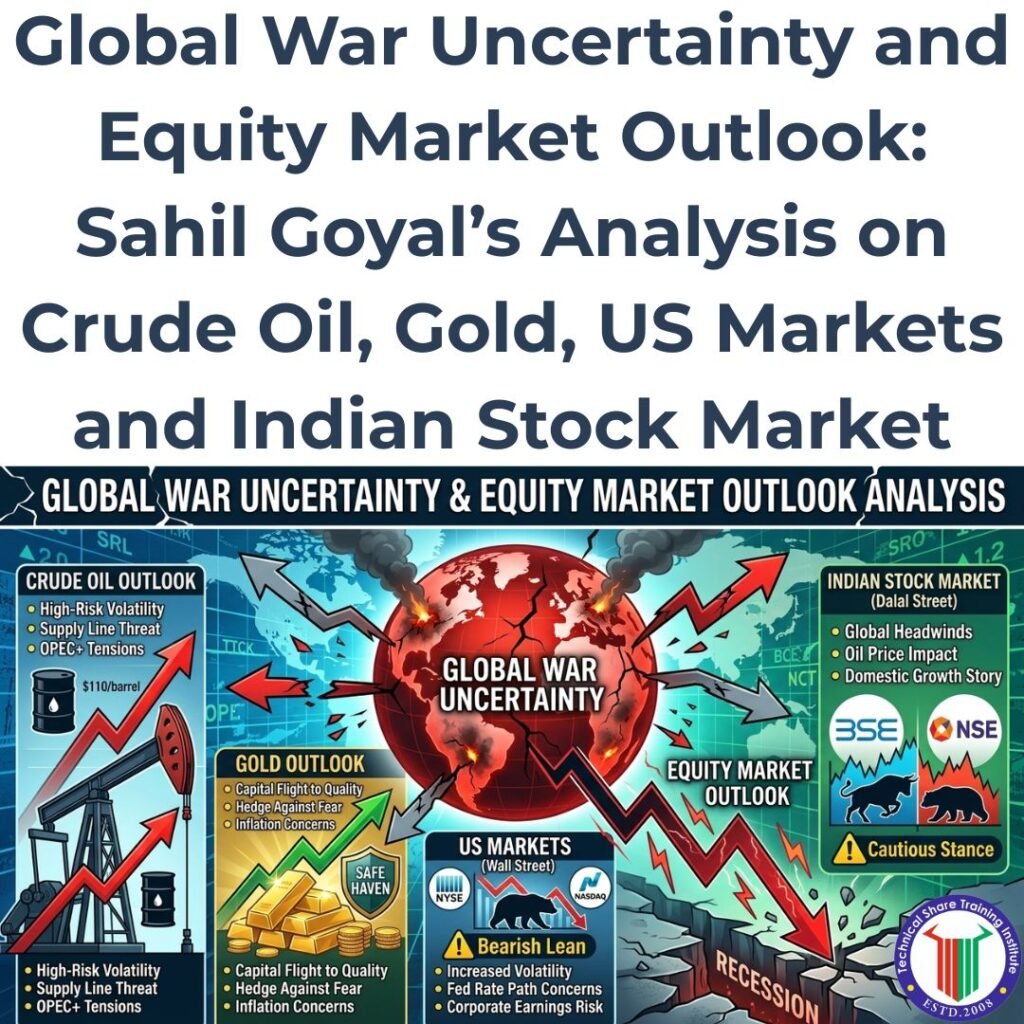
Global War Uncertainty and Equity Market Outlook: Sahil Goyal’s Analysis on Crude Oil, Gold, US Markets and Indian Stock Market
Table of Contents
- Introduction
- Global War Tensions and Market Uncertainty
- Will a World War Actually Happen?
- Why Commodity Prices Rise During Global Conflict
- Crude Oil Outlook During War Uncertainty
- Gold and Silver as Safe Haven Assets
- Global Supply Chain Disruptions
- Equity Markets Reaction During War
- Why the US Stock Market is Under Pressure
- Inflation and Unemployment in the US
- Policy Mistakes and Market Consequences
- Short-Term Outlook for the US Market
- Long-Term Outlook for the US Economy
- Impact on Emerging Markets
- Indian Stock Market Reaction to Global War
- FII Selling Pressure in India
- Domestic Strength of the Indian Economy
- Government Policy Impact on Markets
- Future Global Economic Scenario
- Conclusion
- Who is Sahil Goyal
- Frequently Asked Questions (FAQ)
Introduction
Global financial markets are currently experiencing one of the most uncertain phases in recent years. Rising geopolitical tensions in the Middle East, increasing friction between major global powers, and continuous economic instability have created a strong atmosphere of uncertainty in the world economy.
Investors across the world are closely watching developments related to potential conflicts involving major nations such as the United States, Iran, and their allies. These developments are influencing commodity prices, global equity markets, and investor sentiment.
In this detailed market analysis, Sahil Goyal, a well-known equity and commodity market expert, explains how war uncertainty impacts crude oil prices, gold and silver, US stock markets, and the Indian stock market.
This analysis provides a structured understanding of both short-term and long-term implications for global investors.
Global War Tensions and Market Uncertainty
Financial markets operate heavily on expectations and risk perception. Whenever geopolitical tensions rise, uncertainty becomes the dominant factor affecting investment decisions.
Recent global developments have created concerns about the possibility of a broader international conflict. While headlines often discuss the risk of a world war, the real economic question is how these tensions influence commodity markets, global trade, and investor sentiment.
Market participants are currently dealing with three major uncertainties:
• Potential escalation of military conflicts
• Disruption in energy supplies
• Global economic slowdown
These factors together are responsible for the volatility being witnessed across financial markets worldwide.
Will a World War Actually Happen?
One of the biggest concerns among investors is whether the current geopolitical tensions could escalate into a world war.
According to market analysis by Sahil Goyal, the probability of a world war in the immediate future remains relatively low.
There are several reasons for this:
First, major powers such as the United States and Iran are not currently in a strategic position where a full-scale global war would be beneficial for their economies.
Second, most countries are already dealing with internal economic challenges such as inflation, debt burdens, and slowing economic growth.
Third, global alliances today are complex and fragile. Many countries prefer maintaining neutral positions rather than entering direct military conflicts.
For these reasons, the world is currently witnessing a phase where nations are strengthening their defense capabilities and preparing for future geopolitical challenges rather than engaging in immediate large-scale warfare.
In simple terms, the world is in a “wait and watch” phase.
Why Commodity Prices Rise During Global Conflict
Historically, geopolitical conflicts have always led to higher commodity prices. This happens because war disrupts supply chains and increases uncertainty in global trade.
During periods of conflict:
• Energy supplies become unstable
• Transportation routes become risky
• Production in certain regions slows down
• Governments start building strategic reserves
All these factors push commodity prices upward.
Crude Oil Outlook During War Uncertainty
Crude oil is one of the most sensitive commodities to geopolitical developments. Any tension in oil-producing regions can significantly influence global prices.
In the current scenario, crude oil prices have already increased during the past 1.5 years due to supply disruptions and global economic factors.
According to Sahil Goyal, uncertainty in global politics could keep crude oil prices elevated for a longer period.
Key reasons include:
• Supply disruptions in conflict regions
• Strategic reserves being accumulated by countries
• Transportation challenges in global shipping routes
As a result, crude oil may continue to experience upward pressure in the coming years.
Gold and Silver as Safe Haven Assets
During uncertain times, investors often shift capital from risky assets like equities into safe-haven assets such as gold and silver.
Gold and silver have historically acted as protective assets during economic crises.
When global uncertainty rises:
• Investors increase gold purchases
• Central banks add gold reserves
• Silver demand increases due to industrial use
This trend explains why both Gold and Silver have shown strong price momentum in recent years.
Global Supply Chain Disruptions
War or geopolitical tensions also affect global logistics and manufacturing.
Shipping routes may become unsafe, insurance costs rise, and production slows down in conflict-affected regions.
These disruptions create shortages in certain commodities and products, which further fuels inflation worldwide.
Equity Markets Reaction During War
Equity markets generally react negatively to geopolitical tensions.
Investors become risk-averse and start withdrawing capital from stock markets. As a result:
• Market volatility increases
• Institutional investors reduce exposure
• Equity indices decline
This pattern is currently visible in several major global markets.
Why the US Stock Market is Under Pressure
The S&P 500 and Nasdaq Composite have experienced volatility due to several economic challenges.
These include:
• Rising inflation
• Increasing unemployment
• Economic slowdown fears
• Policy uncertainty
According to Sahil Goyal, policy decisions in the United States have often struggled during implementation stages.
While policies may appear strong on paper, execution and timing play a critical role in determining their actual impact on the economy.
Inflation and Unemployment in the US
Inflation and unemployment together create a difficult economic situation known as stagflation.
If inflation remains high while job growth slows down, consumer spending declines and businesses become cautious.
This environment typically leads to slower economic growth and weaker stock market performance.
Policy Mistakes and Market Consequences
Policy decisions are a key driver of economic direction.
However, the challenge lies in effective implementation.
Economic policies must be executed at the right time and in the correct manner to produce positive outcomes.
If policy decisions fail to deliver expected results, market confidence weakens and investors begin reallocating capital to safer assets.
Short-Term Outlook for the US Market
In the short term, the US market could experience continued downside pressure.
Factors contributing to this include:
• Geopolitical tensions
• Inflation concerns
• Economic slowdown risks
Investors may prefer a cautious approach until economic clarity improves.
Long-Term Outlook for the US Economy
ong-term prospects will depend heavily on policy correction and economic stabilization.
If the United States manages to control inflation and improve employment levels, markets may stabilize over time.
However, geopolitical tensions could continue influencing investor sentiment.
Impact on Emerging Markets
Emerging markets often react strongly to global events because they depend heavily on foreign capital.
When uncertainty increases, international investors typically withdraw funds from emerging markets and move them to safer economies.
Indian Stock Market Reaction to Global War
The NIFTY 50 and BSE Sensex have also witnessed pressure due to global uncertainty.
According to Sahil Goyal, the Indian market has already seen several key support levels break due to continuous foreign selling.
FII Selling Pressure in India
Foreign Institutional Investors have been consistently withdrawing money from Indian equities.
This capital outflow has increased volatility and created downward pressure on stock prices.
When global uncertainty rises, FIIs typically reduce exposure to riskier markets.
Domestic Strength of the Indian Economy
Despite global challenges, India’s domestic economy remains relatively strong.
Government policies aimed at infrastructure development, manufacturing growth, and digital expansion have helped strengthen economic fundamentals.
The economic strategy led by Narendra Modi has focused heavily on long-term domestic growth.
While global sentiment affects market performance in the short term, strong domestic fundamentals can help the Indian economy remain resilient.
Future Global Economic Scenario
The global economy is entering a period of strategic repositioning.
Countries are focusing on:
• Strengthening supply chains
• Increasing defense capabilities
• Reducing reliance on global dependencies
This phase may create volatility but could also lead to new economic opportunities in the long run.
Conclusion
Global markets are currently navigating through a phase of geopolitical uncertainty and economic transition.
While the possibility of a world war remains relatively low in the immediate future, nations are strengthening their strategic positions for potential long-term challenges.
Commodity prices such as crude oil, gold, and silver may remain elevated due to supply concerns and investor demand for safe assets.
Equity markets could continue experiencing volatility, especially in developed markets like the United States.
However, emerging economies like India may remain fundamentally strong despite short-term market pressure.
Investors must remain cautious, diversified, and focused on long-term economic trends rather than reacting to short-term market fluctuations.
Who is Sahil Goyal
Sahil Goyal is a renowned share market expert, commodity analyst, and financial market educator with more than 18 years of experience in the equity and commodity markets.
He is the founder of the Technical Share Training Institute, established in 2008, where thousands of students have been trained in stock market trading and investment strategies.
His expertise spans technical analysis, commodity trading, equity market strategy, and macroeconomic analysis.
Through seminars, market research, and financial education initiatives, Sahil Goyal continues to guide investors and students in understanding financial markets and global economic trends.