📑 Table of Contents
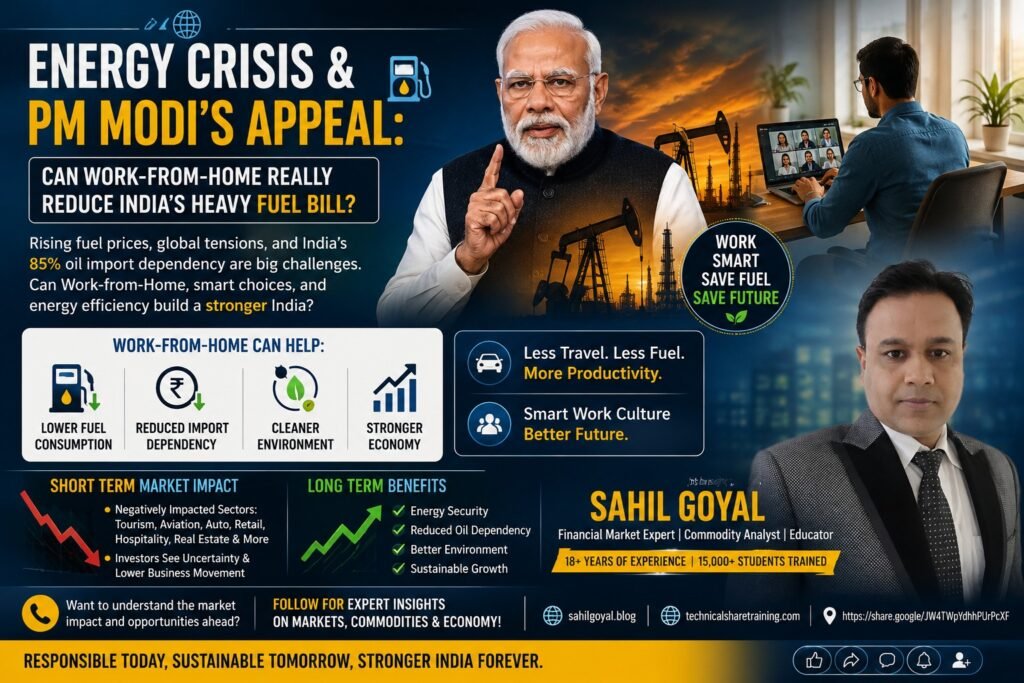
Energy Crisis, Work-From-Home & India’s Fuel Economy: Can PM Modi’s Appeal Really Reduce India’s Oil Dependency?
The growing geopolitical tensions in the Middle East have once again increased concerns about global crude oil prices and energy security. India imports more than 85% of its crude oil requirements, making the country highly vulnerable to rising fuel costs and supply disruptions. :contentReference[oaicite:0]{index=0}
✔ India Imports 85%+ Crude Oil
✔ Hybrid Work Culture Discussion
✔ Fuel Savings vs Electricity Usage
✔ Impact on Stock Markets & Economy
1️⃣ Rising Global Tensions and India’s Fuel Dependency
Whenever geopolitical tensions increase in oil-producing regions, global crude oil prices react immediately. India faces direct consequences because of its dependence on imported oil. :contentReference[oaicite:1]{index=1}
⛽ Rising Fuel Prices
Higher crude prices directly increase petrol and diesel costs.
📉 Inflation Pressure
Transportation and manufacturing expenses increase significantly.
💱 Rupee Weakness
Higher import bills create pressure on forex reserves.
🚢 Supply Chain Risks
Shipping disruptions increase global trade uncertainty.
2️⃣ Can Work-From-Home Really Reduce India’s Fuel Bill?
The logic behind work-from-home is simple — fewer people commuting daily means lower fuel consumption. Cities like Gurugram, Bengaluru, Mumbai, Pune, and Hyderabad consume massive fuel quantities during office hours. :contentReference[oaicite:2]{index=2}
- Reduced daily commuting
- Lower traffic congestion
- Reduced fuel wastage
- Less carbon emissions
- Better urban air quality
3️⃣ The Hidden Reality – Energy Shifts from Offices to Homes
Although work-from-home reduces transportation fuel usage, electricity consumption at homes increases because employees use air conditioners, internet devices, lighting, and electronics for longer durations. :contentReference[oaicite:3]{index=3}
⚡ Higher Electricity Usage
Air conditioners and electronics operate longer during WFH.
🏠 Residential Energy Demand
Urban power consumption may rise significantly.
☀️ Renewable Energy Opportunity
India can shift toward domestic solar and wind power.
💰 Lower Oil Dependency
Electricity generation can reduce imported fuel pressure.
4️⃣ Economic, Corporate & Stock Market Impact
Financial markets reacted cautiously because large-scale work-from-home discussions signal economic uncertainty and weaker business movement expectations. :contentReference[oaicite:4]{index=4}
📉 Negative Sectors
Tourism, aviation, hotels, and retail businesses may face pressure.
💻 Positive Sectors
IT companies, cloud services, and digital platforms may benefit.
📊 Investor Fear
Markets dislike uncertainty during geopolitical tensions.
🌍 Global Sentiment Impact
Indian markets remain connected to global financial trends.
5️⃣ Global Market Outlook
Global equity markets remain under pressure because of inflation concerns, geopolitical tensions, slowing growth expectations, and high interest rates. :contentReference[oaicite:5]{index=5}
- Crude oil volatility
- Inflation fears
- Commodity price increases
- Higher market volatility
- Delayed interest rate cuts
6️⃣ India’s Position – Strong Domestic Economy, Weak Global Sentiment
India’s domestic economy remains relatively strong because of infrastructure spending, manufacturing growth, and digital expansion. However, global market sentiment still impacts Indian equities and investor confidence. :contentReference[oaicite:6]{index=6}
🏗 Infrastructure Growth
Government spending continues supporting economic activity.
🏭 Manufacturing Push
India continues expanding domestic production capabilities.
📉 Imported Inflation
Higher crude oil prices increase inflation risks.
💵 Foreign Investment Pressure
Global uncertainty impacts FII flows into India.
7️⃣ Long-Term Outlook – Is Hybrid Work India’s Future?
Experts believe the future will likely be hybrid rather than fully remote or fully office-based. Hybrid work culture may reduce unnecessary travel while maintaining productivity and business operations. :contentReference[oaicite:7]{index=7}
- Limited office days
- Virtual meetings
- Better public transport systems
- Carpooling culture
- Energy-efficient infrastructure
Frequently Asked Questions
1. Why is India affected by global oil prices?
India imports over 85% of its crude oil requirements, making the economy vulnerable to global price increases.
2. Can work-from-home reduce fuel usage?
Yes, reduced commuting can lower petrol and diesel consumption significantly.
3. Why did stock markets react negatively?
Markets dislike uncertainty and fear weaker business activity during large-scale WFH discussions.
4. Which sectors may benefit from hybrid work?
IT companies, digital platforms, and cloud services may benefit.
5. Does WFH increase electricity usage?
Yes, home electricity consumption generally rises during work-from-home.
6. Why is gold rising during uncertainty?
Gold is considered a safe-haven investment during geopolitical and economic instability.
7. Can India fully shift to permanent WFH?
No, sectors like manufacturing and logistics require physical operations.
8. How does global tension impact Indian markets?
It increases inflation concerns, foreign investor pressure, and market volatility.
9. What is hybrid work culture?
Hybrid work combines office work with remote working flexibility.
10. Who is Sahil Goyal?
Sahil Goyal is a Financial Market Analyst and Commodity Expert with over 18 years of experience.

Sahil Goyal
Financial Market Analyst | Commodity Expert | Share Market Educator
Sahil Goyal has more than 18 years of experience in financial markets, commodities, economic trends, and investor education since 2008.
🚀 Want More Insights on Economy, Crude Oil & Markets?
📈 Follow Sahil Goyal for market analysis & financial awareness
🌍 Stay updated with global economy & stock market trends
💡 Learn smart investing, commodities & market psychology
🏁 Final Conclusion
India’s fuel dependency remains one of the country’s biggest economic vulnerabilities. While work-from-home alone cannot fully solve India’s energy challenges, hybrid work culture may become part of a larger long-term strategy focused on energy efficiency, reduced traffic congestion, and smarter mobility systems. :contentReference[oaicite:8]{index=8}